The owners of the RV park, Mill Creek Camping, also own significant stock in one of the companies that ferry people between Mackinaw City and Mackinac Island. Consequently, they sell tickets, and have shuttle stops for transporting people and bicycles from the campground to the ferry landing. We were the only riders for the 8:40 AM pickup, and arrived just before the big jet-powered boat departed for the island. The first couple of trips of the day usually follow a route that includes passing under the Mackinaw Bridge, and it is an awesome structure, with the main span larger than the main span of the Golden Gate Bridge by 2,000+ feet.

Upon arriving at Mackinac Island, disembarking, and picking up our bicycles, we loaded up and began an 8-mile ride circling the island with bright sunny skies.  The number of people and horses made for a too crowded condition in the pier area, and the stench of horse urine and manure was overwhelming. This changed as we left the shopping and residential area, but the number of bicyclists was significant. And, many of the riders, and particularly the children, had no idea of cycling etiquette, with many near crashes almost happening—enough said as I shall not dwell upon it! Since no automobiles are allowed on the island, the highway is actually a pedestrian and bicycle path. Most of the island is a national park, the nation’s second in fact, operated by the state of Michigan as a state park.
As we neared the end of the circle ride, it began sprinkling; we stopped at the library, parked and locked the bicycles, and dug out raincoats. As we began perusing the various shops, a full-blown rain began, making the covered sidewalks and shops even more crowded. Kay walked through several shops, and we both sampled fudge at a few of the many candy stores. As the rain intensified, the pungent aroma of fudge, horse urine, and liquefied horse manure was unforgettable! We both had to take showers to get the odor out of our noses.

Fort Mackinac was one of our favorite destinations on the island. Established by the British in 1780, the United States took control in 1796. It was the scene of the first land engagement of the War of 1812, and the British recaptured the fort. Despite attempts by the United States to retake the fort, the British maintained possession until returning it after the war. It was used as a prison camp by the Union during the Civil War when then President Andrew Johnson had 3 prominent Tennesseans held captive there. The fort was deactivated in 1895. Some of the fort is original, other parts date back to the late 1700s, and the remaining parts date to the late 1800s. While we were there, re-enactors demonstrated period music, held a court martial, and performed a marching and shooting drill.

From Fort Mackinac, we walked the manure-littered roadway to the Grand Hotel, famous for the longest porch in the world, and site of much of the 1979 filming of Somewhere In Time starring Christopher Reeve and Jane Seymour. For a small fee of $10 each, they allowed us riffraff to have run of the place, consisting mainly of shops and cafes, and of course the famous porch and chairs—pretty expensive sitting!
We walked back to the library, unlocked the bicycles, and caught the next ferry to Mackinaw City. We’re sure glad we visited Mackinac Island, but we don’t understand all the fuss. Our favorite part of the experience was the 8-mile bicycle ride.

After horse urine and liquefied horse manure odor cleansing, i.e. showers, we drove to Cross Village for dinner at the historic Legs Inn, so named for the inverted wooden look alike stove legs forming a border above the first floor roof. The Polish food was as good as advertised, and we were delighted to have made a second attempt to eat there. After dinner, we walked the beautiful gardens overlooking Lake Michigan. Kay will give them an outstanding review on Trip Advisor. We highly recommend it, and would eat there again.


 he Jampot, operated by the monks of Holy Transfiguration Skete, exuded the cacophony of aromas from the many preserves, fruitcakes, breads, and confections prepared on the premises. Kay bought fresh made caramels, jalapeño caramels, and “monk bread”, the latter which must have been soaked in alcohol. Eagle Harbor had a number of notable historic sites including the Eagle Harbor Lighthouse built in 1871 and Eagle Harbor Life-Saving Station Museum (Life-Saving Service was a forerunner to the US Coastguard). Further down the road, Eagle River Falls contained remnants of an old dam and sluice constructed to power a factory which made fuses for the mines. Just downstream from the Eagle River Falls was an old wooden-arched bridge, still in use. We stopped at a small store for lunch, and ordered a pastie—a meat, potato, and rutabaga pie. This delicacy was brought to the area by the wives of the Cornish miners so that the miners would have a hot meal at noontime. We mispronounced it when ordering, and the proprietor said we would have to go to New Orleans or Las Vegas for a “pasty”; however, he had pasties (pass tees). The store’s owner was a 4th generation Cornishman, and the store was built before Abraham Lincoln’s presidency. The Cornish gentleman gave us a great oral history of the area and showed us photographs of Eagle River during its heyday as a major international port on Lake Superior. I asked him about snowfall in the area, and he said they received 390 inches last year—that’s over 22 feet! Turning around, we drove back the way we came, stopping at Silver River Falls for a photo.

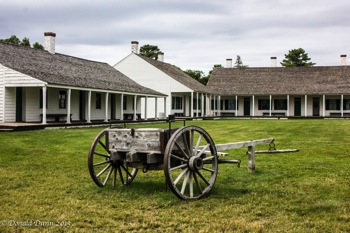 fter dinner, we walked back to Fort Wilkins for the evening’s interpretive program presented by the captain of the Isle Royale Queen IV, one of several ferries to Isle Royale National Park. He talked about things to do on Isle Royale, the wolf-moose relationship, and had lots of pretty photos. The route from Copper Harbor to Isle Royale is the quickest available, but takes 3 hours each way and costs $110 roundtrip per person, plus $60 for kayak or canoe—no wheeled vehicles are allowed on Isle Royale. Consequently, unless a person plans on spending a night or two at a rate of $250 night, the 3-hour passage to Isle Royale, 3 hours on the island, and the 3-hour passage back is not worth either the time nor money to us.

 t one of the natural areas, we passed close by a couple of Sandhill Cranes, and was able to get an up close and personal photo. Spotting a Columbia outlet store, we browsed through the clothes, but didn’t find anything we had to have.
