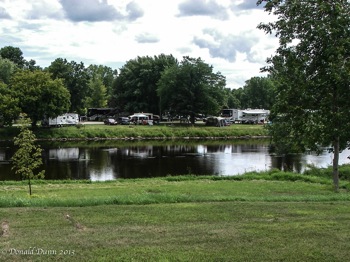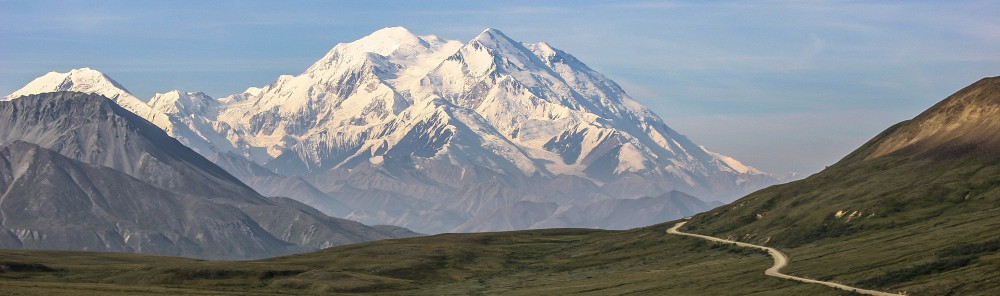
With one more day in Mackinaw City, we both stated our desire to pack up and depart for new horizons. Regretfully, we have reservations and a schedule (a lesson to be learned). Digressing a bit and waxing philosophically, we’ve done most of the RV-related items on the bucket list, except for Washington and Oregon. I’m at a point in our travels, and life, where it’s great just to take the RV somewhere for several weeks, establish semi-residence, and really experience the area; I think Kay feels the same way. And we like spending time at home and with family, particularly in the spring, early summer, and early fall. This might account somewhat for our “hitch itch.” Having said that, Door County, Wisconsin, really struck an accord with us, and it’s a place to which we definitely want to return, perhaps for 6 weeks or so.

Last evening, wind from the northwest began after the partly rainy day, and continued through the night. It was in the low 50s this morning, and winds were gusting at 15 to 20 miles per hour, making it seem even colder. Isn’t there a happy medium somewhere? We drove south again today—our third time—for Kay to further explore Petoskey and Charlevoix, and for me to ride Michigan’s Little Traverse Wheelway. The Little Traverse Wheelway is a paved bike path extending from north of Petoskey south some 23 miles to Charlevoix. Locals reserved much of the waterfront in the 1880s and 1890s for a walking and bicycling path before the railroad claimed it for a railway after the turn of the century. Then when the railroad abandoned it, locals reclaimed it and converted it into a great bike trail. The Little Traverse Bay of Lake Michigan (shown above) shoreline is visible from much of the trail. Just before Petoskey, we pulled onto a side street, unloaded the bicycle, donned helmet and day pack, and bid each other farewell. The trail through Petoskey was awesome, with the high seas crashing against the shore. Winds on the order of 20 miles per hour were forcing the 4 to 5 foot waves directly onto the rocks, and made for spectacular views, but made for very difficult riding when the bicycle trail changed directions and the wind blew directly towards me. Bicycle traffic was heaviest near Petoskey and Charlevoix, but sparse in between. There was little foot traffic. Though only 16+ miles, this was an incredible ride, taking about and hour and a half. It’s definitely worth doing. Kay had just pulled into a parking space at trail’s end as I arrived—great timing.
Kay’s exploration and the bicycle ride ended our activities in the Mackinaw City area. Back at the RV, the tanks were emptied, the RV interior cleaned, and most items stowed for the short trip to Empire, Michigan, tomorrow. That leg of the trip will end our Wisconsin and Michigan tour.
P.S. Michigan has some 1200 miles of bicycle trails, and those we’ve ridden have provided an enjoyable riding experience. They also have a large number of campgrounds, and their residents take advantage of the camping opportunities. We saw lots of young families camping here, in Munising, and in Copper Harbor, and the family units are large by our standards, with each young couple having 4 or 5 children. The Little Traverse Bay area of Petoskey, Charlevoix, and Bay Harbor exude wealth and affluence, and one can only guess that the large houses are mostly summer places for Michiganders (almost all license plates in these places were from the state of Michigan) since there are lots of exclusive golf courses, the summer weather is coo, there doesn’t appear to be any significant business enterprises except for tourism, and the weather here is very cold and snowy from October thru mid-May!

 The number of people and horses made for a too crowded condition in the pier area, and the stench of horse urine and manure was overwhelming. This changed as we left the shopping and residential area, but the number of bicyclists was significant. And, many of the riders, and particularly the children, had no idea of cycling etiquette, with many near crashes almost happening—enough said as I shall not dwell upon it! Since no automobiles are allowed on the island, the highway is actually a pedestrian and bicycle path. Most of the island is a national park, the nation’s second in fact, operated by the state of Michigan as a state park.


 he Jampot, operated by the monks of Holy Transfiguration Skete, exuded the cacophony of aromas from the many preserves, fruitcakes, breads, and confections prepared on the premises. Kay bought fresh made caramels, jalapeño caramels, and “monk bread”, the latter which must have been soaked in alcohol. Eagle Harbor had a number of notable historic sites including the Eagle Harbor Lighthouse built in 1871 and Eagle Harbor Life-Saving Station Museum (Life-Saving Service was a forerunner to the US Coastguard). Further down the road, Eagle River Falls contained remnants of an old dam and sluice constructed to power a factory which made fuses for the mines. Just downstream from the Eagle River Falls was an old wooden-arched bridge, still in use. We stopped at a small store for lunch, and ordered a pastie—a meat, potato, and rutabaga pie. This delicacy was brought to the area by the wives of the Cornish miners so that the miners would have a hot meal at noontime. We mispronounced it when ordering, and the proprietor said we would have to go to New Orleans or Las Vegas for a “pasty”; however, he had pasties (pass tees). The store’s owner was a 4th generation Cornishman, and the store was built before Abraham Lincoln’s presidency. The Cornish gentleman gave us a great oral history of the area and showed us photographs of Eagle River during its heyday as a major international port on Lake Superior. I asked him about snowfall in the area, and he said they received 390 inches last year—that’s over 22 feet! Turning around, we drove back the way we came, stopping at Silver River Falls for a photo.

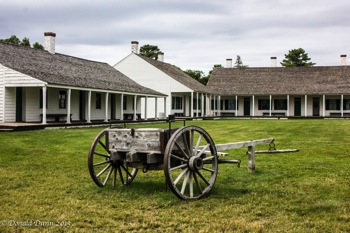 fter dinner, we walked back to Fort Wilkins for the evening’s interpretive program presented by the captain of the Isle Royale Queen IV, one of several ferries to Isle Royale National Park. He talked about things to do on Isle Royale, the wolf-moose relationship, and had lots of pretty photos. The route from Copper Harbor to Isle Royale is the quickest available, but takes 3 hours each way and costs $110 roundtrip per person, plus $60 for kayak or canoe—no wheeled vehicles are allowed on Isle Royale. Consequently, unless a person plans on spending a night or two at a rate of $250 night, the 3-hour passage to Isle Royale, 3 hours on the island, and the 3-hour passage back is not worth either the time nor money to us.