
Our walking tour of Mainz focused mainly on the Old Town and its many historic assets.
Mainz’s Old Town is a charming area known for its historic buildings, picturesque squares, and vibrant atmosphere. It features winding streets, half-timbered houses, baroque churches, and is a place where history and modern life intertwine. The Old Town also offers a variety of shops, restaurants, and wine taverns, making it a popular destination for both locals and tourists. The Old Town is the oldest part of Mainz, with a history dating back to Roman times. It boasts a mix of architectural styles, including half-timbered, baroque, and rococo façades, creating a unique and picturesque streetscape. The Wood Tower is a mediaeval tower in Mainz, Germany, with the Iron Tower and the Alexander Tower one of three remaining towers from the city walls. Its current Gothic appearance dates to the early 15th century. It is so named because wood used to be piled next to it on the bank of the Rhine.

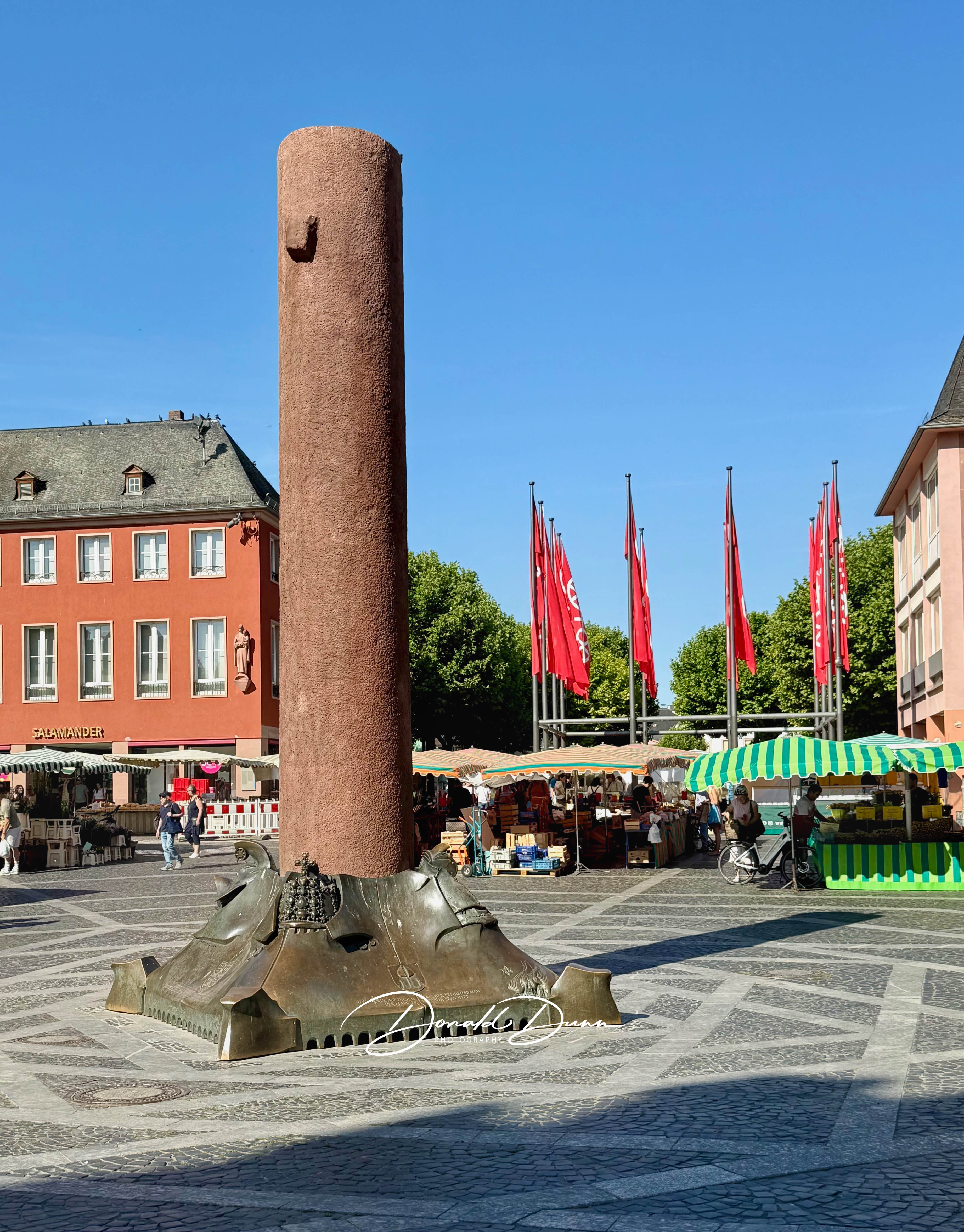
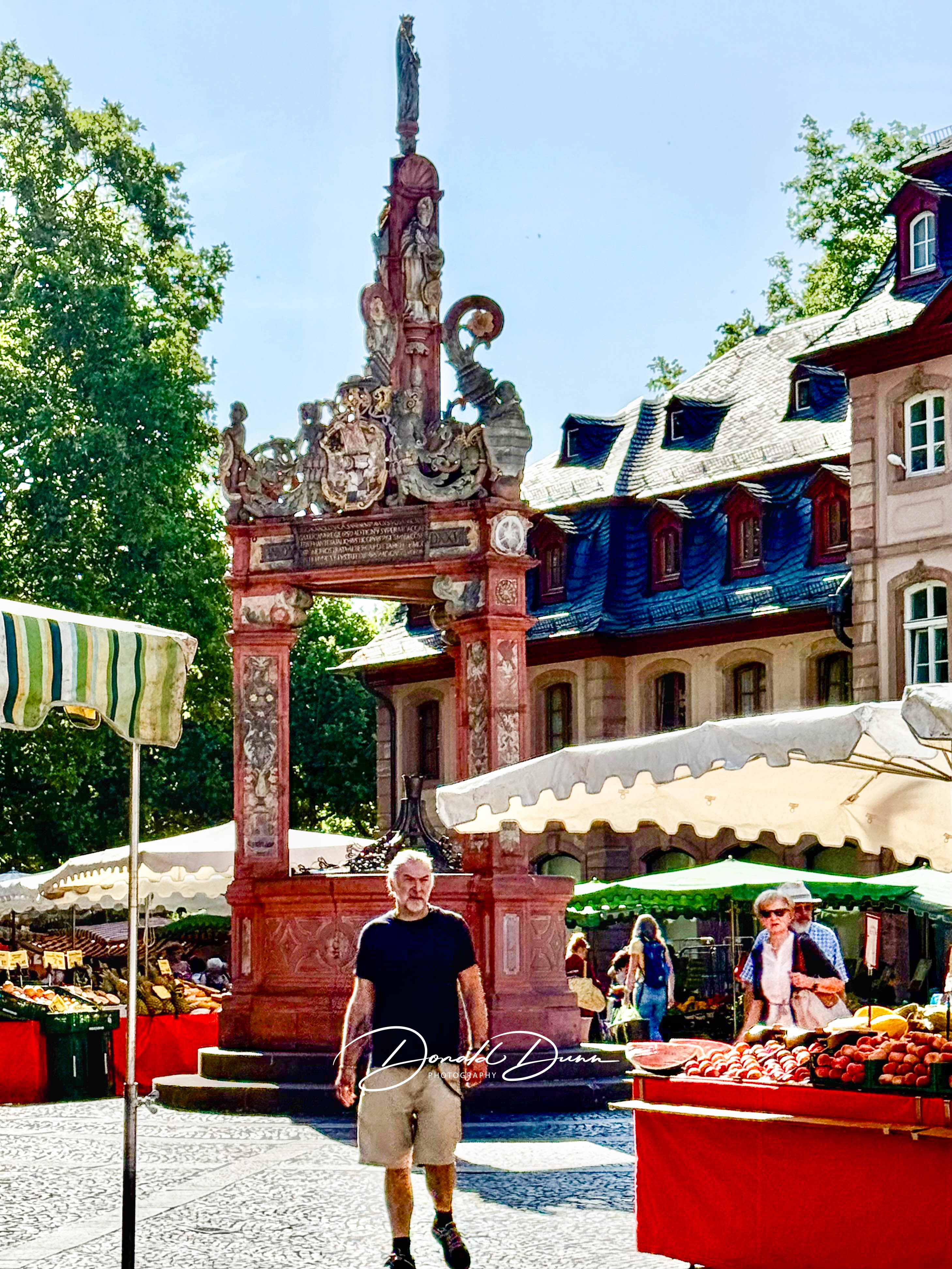
Many smiling locals were enjoying coffee and pastries at the several outdoor cafes in the Market Square. Market Square is Mainz’s most popular square and is dominated by the iconic Mainz Cathedral. The square became a popular trading place when the cathedral was built in 975. Traditionally, merchants offered wool, cloth, fur, baked goods, and fruit and vegetables. Products were set out in large baskets on the floor. The Renaissance market fountain was built in 1526. The water fountain was an important source of fresh water for nearby residents. In 1889, a Madonna figure was added to the fountain. Most of the houses in the square date to the 18th century. World War II bombs heavily damaged Market Square. In 1975, Mainz celebrated the thousandth anniversary of the cathedral and committed to re-designing and rebuilding the square. Many of the buildings were rebuilt with historical facades. The market takes place Tuesdays, Fridays, and Saturdays, and we were fortunate enough to have visited on a Friday. Also, as an aside, Market Square hosts a vibrant Christmas Market during the Christmas holiday season.

Mainz also has some quirky traffic lights.

The magnificent Mainz Cathedral, or St. Martin’s Cathedral, dominates the skyline and is a major attraction in the Old Town. It is situated near the historical centre and market square.

This Roman Catholic cathedral church has stood witness to more than 1000 years of history and is the site of the Episcopal see of the Bishop of Mainz. Together with the cathedrals of Worms and Speyer, the Mainz Dom represents the summit of Romanesque cathedral architecture seen in Germany. Predominantly Romanesque in style, the cathedral has however had later additions to it, making it a wonderful blend of architectural styles from various eras. It is a beautiful experience to see the six red sandstone towers of the St. Martin’s Cathedral rise above the Mainz cityscape with half-timbered houses. To give you an idea about the historic importance of this cathedral, it is enough to say that through the centuries, seven coronations were hosted here. During the World War II, almost 80% of Mainz was destroyed by bombing, but the cathedral had stood unharmed. It is almost completely surrounded by buildings. The largest dome shows a blend of Roman and Baroque styles and beneath it is the transept separating the west chancel from the nave and smaller east chancel. Many supporting pillars in the nave are adorned with carved and painted statues.
The Gutenberg Museum is one of the oldest museums of printing in the world, located opposite the cathedral in the old part of Mainz, Germany. It is named after Johannes Gutenberg, a native son of Mainz and the inventor of printing from movable metal type in Western Europe and focuses on him and his inventions. The museum’s collection includes two original Gutenberg Bibles that date back to the middle of the 15th century and are widely regarded as some of the finest books of all time.

The reconstruction of Gutenberg’s workshop is another main attraction, and our guide demonstrated what the printing process would have been like in Gutenberg’s day.


The Collegiate Church of St. Stephan, known in German as St. Stephan zu Mainz, is a Gothic hall collegiate church located in the German city of Mainz. It is known for windows created by Marc Chagall. St. Stephan was originally built in 990 at the order of Archbishop Willigis, who also initiated the building of Mainz Cathedral. The current church building dates from the late medieval era; construction of the main area of the church began in about 1267 and was completed in 1340. St. Stephan was heavily damaged in the bombing of Mainz in World War II. The Chagall choir windows in St. Stephan are unique in Germany. Between 1978 and his death in 1985, Russian Jewish artist Marc Chagall created nine stained-glass windows of scriptural figures in luminous blue. The figures depict scenes from the Old Testament, demonstrating the commonalities across Christian and Jewish traditions. Chagall intended his work to be a contribution to Jewish-German reconciliation, made all the more poignant by the fact that Chagall himself fled France under Nazi occupation.

 Dunngone's Photos and Blog