Saturday, September 15, 2012—Lunenburg, Nova Scotia

After a restful night’s sleep in a great B&B, I enjoyed coffee made from dark roasted beans brewed in their Keurig coffee maker—almost as good as being at home.

The Atlantic Sojourn is so comfortable and complete, that one cannot help but relax and enjoy reading, listening to music, or other similar activities. I took advantage of the peace and quiet in one of their comfortable common areas, catching up on local news and emails on the IPad before other inn guests awoke and began to stir. After conversation with other guests over coffee, we all sat down for breakfast.  I had orange juice, oatmeal with raisins and brown sugar, poached eggs, maple and smoke flavored bacon, and English muffin.  This breakfast was complete, and almost as good as the Innisfree B&B in Hopewell, New Brunswick.

Harbor at Lunenburg, Nova ScotiaWith nothing really planned for the day, we all walked to the harbor front, where John and Sandy split off to do a house tour.

Kay and I continued to the harbor, taking pictures along the way, and then Kay split off to shop while I walked the remainder of the historical district, amazed at all the colorful houses and shops.It's fall in Lunenburg, Nova Scotia I returned to the B&B and worked on the blog, almost bringing it up to date, immensely enjoying free time. Kay joined me, and after a couple of hours, we walked back to the harbor front and spent an hour or so in their local museum. John and Sandy came by just as we finished the museum, and Kay and I returned to the B&B. We all looked forward to dinner at Olde Black Forest Restaurant, a Local German eatery. While it was good, I think we were all a little disappointed as it wasn’t quite what we expected.

The rest of the evening was spent packing for our return to Halifax and the last whole day in Nova Scotia.

– Posted using BlogPress from my iPad

Friday, September 14, 2012—Canada Parks Screwed Up

After a good night’s sleep, we met for breakfast, which was adequate, with a much more attentive and friendly Garrison House Inn staff member. We walked across the street to the Fort Anne National Historic Site, only to find that they closed on Friday and Saturday. Apparently, Parks Canada is facing severe budget cuts, and opted to close this site on what they maintained were the least visited days of the week. Even local merchants and inn keepers were unaware of this.  120914_Edited-1Nevertheless, we walked the one half kilometer trail around the grounds of this star-shaped fort. Fort Anne was built to protect the harbor of Annapolis Royal, Nova Scotia. The fort repelled all French attacks during the early stages of King George’s War. It is now operated, except for Friday and Saturday, as Fort Anne National Historic Site, within the national park system and managed by Parks Canada. The 1797 officer’s quarters was renovated in the 1930s and now house the museum with exhibits about the fort’s history and historic artifacts from the area. Regrettably, we were unable to experience much of this site.

From Fort Anne we drove the short distance to Port Royal-The Habitation only to find it too closed on Friday and Saturday. The Habitation was established by France in 1605 and was that nation’s first successful settlement in North America. Port-Royal served as the capital of Acadia until its destruction by British military forces in 1613. France relocated the settlement and capital 5 miles upstream and to the south bank of the Annapolis River; the site of the present-day town of Annapolis Royal.  The relocated settlement kept the same name "Port-Royal" and served as the capital of Acadia for the majority of the 18th century until the British conquest of the colony in 1710, at which time the relocated settlement was renamed Annapolis Royal. The replica village resulted from significant lobbying by both part time and permanent residents. In the early 1900s, chiefly under the leadership of Harriet Taber Richardson, native of Cambridge, Massachusetts, and summer resident of the nearby town of Annapolis Royal, Nova Scotian preservationists and historians began lobbying the Government of Canada to build a replica of the Habitation which stood from 1605 until its destruction in 1613. The government agreed, after much persuasion, to have the replica built on the original site. Construction took place from 1939-1941 and was based on a duplicate set of plans for the original Habitation that had been recently discovered in France. This reconstruction was the first National Historic Site in Canada to have a replica structure built. On May 25, 1925, the Government of Canada’s Historic Sites and Monuments Board of Canada recognized the original Habitation at Port-Royal in the community of Port Royal, Nova Scotia for its heritage significance and granted the designation of the Port-Royal National Historic Site of Canada. In the 1930s the site of the original Habitation was located in the community and the results of archeological excavations fed public interest in the period of the original French settlement. This interest had been increasing since the publication of Quietly My Captain Waits, an historical novel by Evelyn Eaton set in Port-Royal in the early 17th century.

Kay's favorite rose bud, Annapolis Royal Historic Gardens, Nova ScotiaDisappointed by the closure of these two significant historical sites, we agreed to tempt fate and asked Kay to negotiate an early departure from the Garrison Inn, thinking it wouldn’t happen. She was successful (though I wasn’t surprised), but that left us without accommodations for the evening. We quickly packed and checked out, grateful that the otherwise "unfriendly" inn granted our request.

Before we departed Annapolis Royal, we toured the Annapolis Royal Historical Gardens which proved to be an awesome experience, far better than expected, and the highlight of our time in Annapolis Royal. They employ 10 gardeners to oversee the various vegetables and plants. We spent a couple of hours there and could have spent all day. The photo was taken in their expansive rose garden.

Leaving Annapolis Royal, we drove south to Digby to again sample their fine dining. Kay and Sandy had scallop "sandwiches", John had sausages, and I had fish cakes. The food was scrumptious. The restaurant is one of our two favorites in the Maritimes.

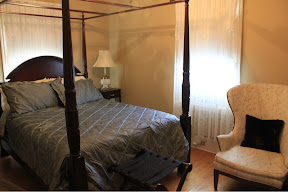
Our drive to the eastern shore was through a heavily forested lake region, reminding us of the lake region of the north woods in Minnesota. Both John and I were much interested in the smallmouth bass and brook trout fishing, but that will have to wait for the next trip. Our B&B, the Atlantic Sojourn, in Lunenburg, Nova Scotia (we definitely recommend this B&B)Near Lunenburg, Kay called the Atlantic Sojourn B&B where we had reservations for tomorrow evening, and they had two vacancies for this evening. We arrived shortly after Kay’s call, and were greeted by Sebelle, one of the two owners. We felt instantly at home as Sebelle is from Natchez. She and Susan have a super B&B, have left nothing to chance, thinking of everything.

We had dinner at a highly recommended pub, and though noisy, the food was great. After dinner, we spent some time relaxing in the lavishly appointed common areas, and then retired to our bedrooms for the evening.

– Posted using BlogPress from my iPad

Thursday, September 13, 2012—Back to Nova Scotia

120913_Edited-2Our B&B, Innisfree B&B in Hopewell, New Brunswick, has set the bar rather high for both accommodations and breakfast. The owners and operators, a relatively young couple from Montreal, have done an outstanding job of providing clean, spacious, and more than adequate accommodations; the landscaping is relaxing, simple, and natural with a wonderful walking path beginning with a collection of lobster trap buoys. 120913_Edited

And the breakfast was to die for! The multi-course breakfast consisted of juice and a simple, but tasty homemade blueberry scone, accompanied by butter and several jams; an oversized martini glass filled with fresh fruit, all locally grown, including sweet wild blueberries, topped with yogurt and homemade granola; and lastly, huge Belgian waffles with locally made maple syrup. Allen, who with his wife, own the place, was alone during our stay while his wife was on holiday, but successfully managed to see to our every need, including preparing this sumptuous breakfast.

Grand-Pré National Historic Site of Canada, the basis of Longfellow's Evangeline, shown as a statue here, in Nova ScotiaDriving a large, almost circuitous route, we returned to Nova Scotia, traveling through largely uninhabited country. At Truro, we turned south, and were awed by the sparse, but neat farms on Nova Scotia’s upper west coast. In the largely pastoral countryside, we saw beautiful villages with their white churches and colorful houses. Further down the coast, on the Evangeline Trail, we toured the Grand-Pré National Historical Site. Grand-Pré National Historic Site of Canada commemorates Grand-Pré area as a center of Acadian settlement from 1682 to 1755 and the deportation of the Acadians, which began in 1755 and continued until 1762. Grand-Pré was the basis of Henry Wadsworth Longfellow’s Evangeline. Though not positive, we believe my mother’s paternal side of the family, the Malotts (Maillet), included members expelled from this area to Maryland in the 1755 to 1762 period, then to Indiana, and finally to Arkansas.

Maillet, one of my ancestors expelled and deported from Nova Scotia with the rest of the Acadians?After the day’s long drive, we arrived in historic Annapolis Royal for our overnight accommodations at the Garrison Inn. After a long wait, we were "acknowledged" by a young, inattentive innkeeper, who did little to make us feel welcome. Our room was quite small, and unadorned. After checking in we drove south to Digby, the scallop capital of the world, where we had an outstanding dinner of grilled scallops, baked potato, and fresh vegetables. And their lemon meringue pie was almost as good as my mom used to make. This was a great way to end the day!120914_Edited

– Posted using BlogPress from my iPad

Wednesday, September 12, 2012—New Brunswick and the Bay of Fundy

Today is Sandy’s birthday, and we celebrated by serenading her in the hotel lobby.

We departed PEI early this morning in order to see the high tide at Hopewell Rocks on the Bay of Fundy. We crossed the Confederation Bridge, the longest bridge in the world over ice-covered waters, paying our toll on the bridge approach. As an island, PEI is somewhat isolated, with only two ways in or out by automobile: the ferry and the Confederation Bridge. The toll is collected only on the way out! As soon as we crossed, we were in New Brunswick. We drove to near Moncton, where we stopped for breakfast and coffee, and continued towards the Bay of Fundy, surprisingly seeing a ring neck pheasant on the outskirts of Moncton.

120912-6The Bay of Fundy is famous for having the highest tidal range in the world with, reaching a differential as high as 53.5 feet between high tide and low tide.  Today, we experience a very moderate tidal differential of only 22.6 feet.  In just a few days, on September 19, it will be 44.0 feet

The Hopewell Rocks, also known as the Flower Pot, is a provincial park that provides an opportunity to view high tides, and then walk on the ocean floor at low tides.  We rushed to be there at high tide.  Kay at water's edge at high tide, Hopewell Rocks, Bay of Fundy, New BrunswickAfter paying our entrance fee, and walking down the trail to the observation point, there was only a narrow band of beach exposed; we were a few minutes late, but the high tide had only dropped a few inches. We walked among the rock formations, on the narrow beach, taking pictures to compare with the same area at low tide later in the afternoon. The reddish brown color of the water was surprising, but takes on the color of the soil along the New Brunswick coastline, and the ever-changing tide keeps the water and soil agitated, giving the water this unusual color.

Kay, John, and Sandy at one of many covered bridges we saw in New BrunswickLeaving Hopewell Rocks, we drove south through beautiful countryside, noting the predominance of old, beautiful Baptist churches; we’re not sure if they maintain the same mostly evangelical beliefs of Baptist churches back home, but they easily outnumbered all other denominations combined. Along the way, we saw our first of several covered bridges.

120912-36Continuing south along the Bay of Fundy coast, we "detoured" off the main highway towards Cape Enrage. All of us—Sandy, Kay, John, and I—really enjoy taking routes on roads less traveled. Even off this loop, we found still another one that took us to an historic shipbuilding town, a road across a tidal barrier dam, and another out-of-the way road through one of Canada’s national wildlife preserves. The sparse farms and small villages were all neat and clean, and all the buildings looked freshly painted. Again, we saw a multitude of old mostly white churches, with a vast majority being Baptist.

120912-62This out-of-the way drive took us to Cape Enrage Lighthouse, sitting on a large cape jutting out high above the Bay of Fundy. I hesitated to pay the fee to access this area, but am glad I did. Again, I took the stairs down to the sea "floor" to walk among the clumps of sea weed and fossil embedded rocks. We had a great lunch at their cafe. Cape Enrage was not on our itinerary, but proved to be one of the most scenic places we visited.  It had barely escaped closure, but a private, not-for-profit entity took control, opened the restaurant, and to assist in funding, built some zip lines, provided kayak tours, and developed some other outdoor entertainment.  We were there in the off season, and it was not crowded.

Arriving at Fundy National Park, we were confused by directions to scenic views, and the lack of road and highway signage, though this seems to be the rule rather than the exception in all the Maritime Provinces. Consequently, we drove the breadth of the park, missing what we thought was a lighthouse view.

120912_Edited-8Low tide was approaching, so we returned to Hopewell Rocks where we all walked among the many rock formations now exposed.  Walking on the ocean floor, and sea weed, did not seem like much of a feat, until one realized that only a few hours ago it was covered with water. Again, the tidal differential today is a mere 22.6 feet, but has reached as much as 53+ feet, the highest recorded in the world. 120912_Edited-14

After seeing this "life list" item, we found our B&B, checked in, and relaxed in the spacious quarters and common areas. Dinner was at a dude ranch, and was good, wrapping up a long, but rewarding day.

– Posted using BlogPress from my iPad
Tuesday, September 11, 2012—Prince Edward Island

We crossed to Prince Edward Island on a ferry just like thisAfter our last breakfast at the Bell View B&B, we loaded our luggage and drove south and west to Caribou, Nova Scotia, to catch the ferry to Prince Edward Island (PEI). The ferry route was 14 miles, and with the effects of the just passed hurricane lagging behind, the seas were a bit rough.

None of us knew quite what to expect of PEI, but we were not prepared for its mostly rural nature and the extent of farming on the island. 120911-7We drove from the ferry landing northwest towards Charlottestown, then through this capitol city’s historic district (reminding us of Charleston, SC) of Charlottetown. We then drove to the northern coast, and along the Prince Edward Island National Park beaches.  Folks throughout the Maritime Provinces are really proud of these beaches; they are quite different from ours, particularly those idyllic white sand beaches along our Gulf of Mexico coast in Florida and Alabama.  I’m sure we take them for granted.

Large fox, Prince Edward IslandAs we were leaving the Prince Edward Island National Park, Sandy spotted a pair of foxes along the road.  We stopped just long enough to snap a few pictures.  The foxes are larger than those at home, and a different color.  They were, however, quite beautiful.

House on farm that was the basis of Anne of Green GablesAt Cavendish, we toured the Anne of Green Gables farm. Green Gables is a popular tourist destination. Each year hundreds of thousands of visitors from around the world visit the site which inspired the setting for L.M. Montgomery to create her beloved tale of a red-haired orphan, Anne of Green Gables. In addition to the Green Gables House, several museums and sites invite visitors to learn more about Anne and Montgomery.

One of many old churches we saw in the Maritime Provinces. This was on Prince Edward Island.It was then time to drive south for our overnight accommodations in Summerside, PEI.  As with the rest of the Maritime Provinces, we saw lots of old churches.  Most of them were white, and had tall bell towers.

After checking into our hotel, we rested briefly, had dinner at a restaurant near the hotel, and retired for the evening.

– Posted using BlogPress from my iPad

Monday, September 10, 2012—Alexander Graham Bell National Historic Site

We awoke to rain and wind as we were on the western edge of a major hurricane passing through the western part of the Northern Atlantic.  We were lucky with only lots of rain and wind, because the hurricane hit just north of us on the eastern coast of Newfoundland.

Today was a catch-up day, with time for shopping, hanging out, fishing, or any thing else that suited our fancy.

Alexander Graham Bell, most famous as the inventor of the telephone, chose to build his Canadian residence in Baddeck on Cape Breton. According to Bell, "I have travelled the globe. I have seen the Canadian and American Rockies, the Andes and the Alps and the highlands of Scotland, but for simple beauty, Cape Breton outrivals them all." The Alexander Graham Bell National Historic Site is a 25-acre park overlooking the Bras d’Or Lakes, a saltwater inland sea. This complex, with its three exhibit halls, contains the largest collection of Bell’s artifacts and inventions, including replicas of the first telephones and a full scale model of the HD-4 hydrofoil craft. Bell invented many, many things but considered the hydrofoil his most important. We spent a couple of hours visiting the complex, a good rainy day activity.

Kay and Sandy tried to shop in the wind and rain, while John visited with a local "guide" to find out more about trout and Atlantic salmon fishing in the Margaree Valley. He reported back that the guide said one prominent fisher had fished the area 27 years without catching an Atlantic salmon—glad we didn’t book a trip! We all had lunch at the Yellow Cello, a local hangout, and it was decent fare.

Lunch was followed by a drive to Cheticamp, where Kay and Sandy toured a hooked rug museum, and we all toured an old Acadian Catholic church. Cheticamp is a unique Acadian village on the west coast of Cape Breton. It is now a fishing community on the Cabot Trail at the western entrance of the Cape Breton Highlands National Park.  The downtown area overlooks a large protected bay on the Gulf of St. Lawrence.  It has about 4,000 residents, most of whom speak French as well as English.  It is absolutely Acadian in culture, and the largest French community on Cape Breton Island.  We returned to Baddeck, and had dinner at the Telegraph Inn. They had music, but it was more of a dinner type music.

120910_Edit_28We left there and attended a ceilidh in town. The young fiddler, Mike Hall, was a native of New Brunswick, and was extraordinary, providing lots of information about Celtic music and ceilidhs intermixed with his playing of reels, jigs, strathspeys, and waltzes, all Celtic music tunes. He said he had some 2500 tunes in his repertoire. Some of the more daring visitors were given a square dance lesson as the Celtic music played. This was one of many highlights of our time on Cape Breton Island.

– Posted using BlogPress from my iPad

Sunday, September 9, 2012—Fortress of Louisbourg

We keep getting up later and later as we acclimate to the Atlantic Time Zone—thank goodness, as I can’t get to sleep until early morning. By the way, the Atlantic Time Zone is two hours in front our Central Time, i.e. 8 AM in the Atlantic Time Zone is 6 AM in the Central Time Zone.

After another great breakfast at the B&B, we departed Baddeck, driving east to Sydney and then south to Louisbourg National Historic Site of Canada. It was foggy and misting rain, weather which would remain with us for the entire day. We arrived at the Fortress of Louisbourg shortly after 11 AM, presented our Canada Parks pass, and caught the shuttle to the Fortress grounds.120909_Edit_11
The Fortress of Louisbourg (French: Forteresse de Louisbourg) is a national historic site and the location of a one-quarter partial reconstruction of an 18th century French fortress at Louisbourg on Cape Breton Island, Nova Scotia. Its two sieges, especially that of 1758, were turning points in the Anglo-French imperial struggle for what today is Canada.

The original settlement was made in 1713, and initially called Havre à l’Anglois. Subsequently, the fishing port grew to become a major commercial port and a strongly defended fortress. The fortifications eventually surrounded the town. These walls were constructed mainly between 1720 and 1740. By the mid 1740s Louisbourg was one of the most extensive (and expensive) European fortifications constructed in North America. Fortress Louisbourg suffered key weaknesses, since it was erected on low-lying ground commanded by nearby hills and its design was directed mainly toward sea-based assaults, leaving the land-facing defences relatively weak. Captured by British colonists in 1745, it was a major bargaining chip in the negotiations leading to the 1748 treaty ending the War of the Austrian Succession, and was returned to French control from British in exchange for Indian city of Madras. It was captured again in 1758 by British forces in the Seven Years’ War, after which it was systematically destroyed by British engineers. The fortress and town were partially reconstructed in the 1960s, using some of the original stonework and providing jobs for unemployed coal miners in the effort. (Wikipedia)

120909_Edit_12We quickly made our way to the Governor’s Hall and parade grounds to observe firing of one of the cannons.  Only about one pound of powder was used, and it made a big bang—during the real battles, 6 pounds were used.  The photo shows the plume of smoke, and if one looks carefully, the cannon crew has their fingers in their ears.

120909_Edit2_01We toured the Governors Hall, and the many rooms used for living, cooking, meetings, business of the area, and essentially any other activities that would allow it to be self sustaining.

120909_Edit_15While this was a magnificent building, with lavish and luxurious amenities for the upper echelon, it was a real eye opener to see and hear how the young French soldiers lived, for they were ill fed, lack warm clothes, and worked long, hard hours—but it beat what they would have experienced back in France.

We then made our way through the other streets and alleys to the many buildings and their rooms making up the fortress.

120909_Edit_25Because this was a living museum, we were able to visit with the many characters in period dress, reenacting every day life in a mid-1700s French settlement in the new world.  They spoke to us as if we they were actually living in the These included cooks, officers, soldiers, blacksmiths, priests, engineers, sailors, and a full cadre of citizenry making up a village during that time period.120909_Edit_19


We even had lunch in the village, served on utensils that would have been popular during the period and by a waitress dressed in costume.  The food was mediocre at best.

Following our visit to Fortress of Louisbourg, we spent considerable time trying to find the Marconi historical site. Regrettably, this was apparently not an important site despite being designated a national historic site, and road work in the area made finding the site near impossible. Through John and Kay’s astute navigation abilities, we finally found the site, only to find it closed and the building empty. Apparently, Parks Canada has been undergoing severe budget cutbacks.  Nevertheless, we walked among the ruins where the towers had been built, and the first radio signals beamed.

Back at Baddeck, we had lobster dinner at Telegraph Hill and it was both very good and relatively inexpensive, two of my most important criteria for a restaurant.

– Posted using BlogPress from my iPad

Saturday, September 8, 2102—The Cabot Trail and Cape Breton Highlands National Park

120908_EB01After a good night’s sleep at the bed-and-breakfast, and a great breakfast in their dining room, we filled up with gas ($1.41 per liter, and almost 4 liters per gallon equals about $5.60 per gallon) and began our drive east and north to encircle Cape Breton Island. The coastal road around the top two-thirds of the island is known as the Cabot Trail, and the area is the Cape Breton Highlands National Park.

120908_EB02Our start was slow, as we stopped at a couple of shops, and were fortunate enough to see a bull moose just adjacent to the side of the road.

We finally made it to the park entrance where we bought a "group" Canada Parks pass, because it would be cheaper than individual passes to all the activities we plan to visit over the next several days. 120908_EB03We opted to drive in a counter clockwise direction, despite warnings that this would put us on the edge of the high cliffs along the ocean—these warnings proved to be unfounded. Even the drive at the beginning of the Cabot Trail provided awesome views, including a whale blowing in the distance. 120908_EB04

We diverted to a secondary road at Nell’s Harbour, enjoying one of the most scenic portions of our trip, including driving through a small fishing village tucked away on the coast, replete with boats and stored lobster traps. Sandy wants to import these to the US and sell them to antique stores as collectibles!  We saw some along side the road for $5, and they would sell easily in the US for $20.

120908_EB05At Cape North we diverted again, taking the sometimes paved and sometimes gravel road all the way to its end at Meat Cove, high above Bay St. Lawrence; we drove to the further most point north on Cape Breton Island! Meat Cove was a small village with only a few permanent residents, consisting mostly of a campground along the coast.

120908_EB06Driving south, we reconnected with the Cabot Trail and began driving southwest, stopping at Chulps Beulach Ban Falls, before turning west. Though not impressive at first, the falls was surprisingly high.

At Pleasant Bay we hit the west coast, at the Gulf of St. Lawrence. We stopped a couple of times along the road at parking areas seemingly hanging just atop the cliffs and looked hard for whales, but did not see any.

Further south we exited the Cabot Trail at Cheticamp where we had dinner at the Acadian Restaurant. Kay, Sandy, and I had fish cakes, and John had meat pie. For dessert we had blueberry pudding, butterscotch pie, and strawberry rhubarb pie. The food was awesome.

Following dinner we drove back to the bed and breakfast, read, and retired for the night after a super good day.

120908_EBB01This is awesome road trip, and is a must-see for anyone traveling to Nova Scotia. If we had unlimited time, it would have been great to do some bicycling, hiking, and kayaking.

Maybe next time…

And, despite warnings, we did not find the counterclockwise drive to be difficult or threatening in the least.  Of course, after the Going to the Sun Road and Beartooth Highway in Montana, this was pretty bland. 
– Posted using BlogPress from my iPad

Friday, September 7, 2012—Our First Day in Nova Scotia

We awoke really early this morning, about 5:30 AM—that’s 3:30 AM our time. After a cup of hotel room coffee, a shower, and re-packing, we caught up on email, read news from back home, and glanced at national and world news. John and I met in the lobby, and caught a shuttle back to the airport for a rental car. We returned to the hotel to pick up Kay, Sandy, and our luggage, and were on our way. Our first stop was just down the road at Tim Horton’s for coffee and a breakfast sandwich. Tim Horton’s is the coffee shop of choice in Canada. After breakfast, we continued northward, and about 11 AM we noted a sign for McLobster, advertising lobster rolls at McDonald’s. Of course we had to stop and give them a try.

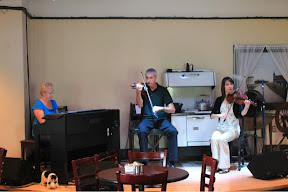
We then drove east and further north another hour or so to the Celtic Music Centre at Judique, Nova Scotia, for lunch and a ceilidh (pronounced "cay lee"). Lunch was good, but the ceilidh was great, featuring two fiddle players and a pianist. In addition the young woman demonstrated the step dance, a Scottish dance. Both the music and the dance reminded me of Mountain View, Arkansas.

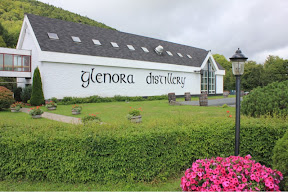
We continued our drive further north and again east to Baddeck, Nova Scotia, for dinner and our overnight accommodations, with occasional glances at the western coast of Cape Breton Island. Along the way, we saw old churches and small harbor towns in an otherwise undeveloped countryside. We also saw a single malt "scotch" distillery, but they cannot call it scotch because it is not made in Scotland. It is the only single malt whiskey made in North America, and no, we did not sample—too expensive!

We arrived at the Bell View Bed and Breakfast in Baddeck, our overnight accomodatons, squeezed luggage into the small, over furnished room (no room for luggage), and enjoyed some quiet time for about an hour.

We had dinner, lobster of course, at the recommended Bell Buoy restaurant, and the food was okay, but much too expensive. We wrapped up the evening catching up on our reading.

– Posted using BlogPress from my iPad

Thursday, September 6, 2012—Little Rock,Arkansas, to Halifax, Nova Scotia

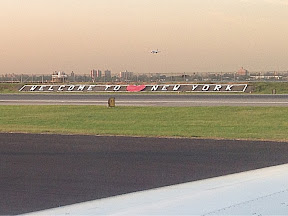
After overnighting in the Holiday Inn Airport in Little Rock, we caught the shuttle to the airport. There were hardly any lines, and checking our bags and making it through the security barriers was fairly easy. Our travel today included 3 flight legs: Little Rock to Atlanta, Atlanta to New York, and New York to Halifax. We departed Little Rock at 10:30 AM, and briefly crossed paths with John and Sandy, with whom we are touring Nova Scotia, in Atlanta as they made an earlier flight from Atlanta to New York. We met up with them in New York, and together boarded our plane to Halifax.

Up until then we were on schedule, but the plane was overweight, and it took the crew an hour to sort it all out, offering compensation to several passengers who opted deboard and wait for a later flight. We did arrive in Halifax near our schedule, but we were all a bit frazzled, and the Canadian border agent Kay and I got (their equivalent of our border patrol) was not real nice, an experience we’ve had several times crossing from the USA to Canada, and vice a versa. Oh well, all’s well that ends well.


– Posted using BlogPress from my iPad